Challenges in Public Sector ERP Programs (and How to Navigate Them)

Table of Contents
1. The Growing Complexity of Public Sector ERP Programs
Public sector ERP programs have evolved into highly complex enterprise transformation initiatives involving finance, procurement, payroll, HR, grants management, budgeting, compliance reporting, analytics, cybersecurity, and citizen service enablement. Unlike traditional IT projects, ERP modernization affects nearly every operational area across government institutions.
A modern public sector ERP program may involve dozens of agencies, hundreds of integrations, thousands of users, multiple vendors, external oversight committees, unionized workforces, and extensive compliance requirements operating simultaneously over several years.
This complexity increases significantly because many government institutions operate within decentralized structures. Agencies frequently maintain independent workflows, reporting standards, approval hierarchies, procurement models, and operational procedures developed over decades. ERP programs attempt to standardize these fragmented environments into integrated enterprise platforms.
As organizations pursue standardization, resistance often emerges from departments concerned about losing operational flexibility or disrupting mission-critical services. These conflicts frequently lead to customization growth, delayed decision-making, governance bottlenecks, and increased implementation risk.
Legacy system coexistence further complicates ERP transformation. Most public organizations cannot replace all operational systems simultaneously. ERP programs therefore operate within hybrid environments where old and new systems must function together during transition periods. This increases integration complexity, testing requirements, operational dependencies, and deployment risk.
Public sector ERP programs are also highly visible initiatives subject to public scrutiny, audit oversight, and political accountability. Decisions related to budget, implementation timelines, compliance controls, and operational disruption may attract attention from legislators, regulators, oversight boards, and media organizations.
As a result, public ERP transformation requires enterprise-level governance capable of integrating technology modernization with operational continuity, organizational readiness, compliance management, and long-term institutional stability.
2. Governance Fragmentation and Leadership Challenges
Governance fragmentation is one of the largest structural risks within public sector ERP transformation.
Government institutions often operate as federated organizations where agencies maintain significant autonomy regarding budgeting, procurement, reporting, workforce management, and operational procedures. Over time, these agencies develop independent governance cultures that complicate enterprise-wide ERP standardization.
During ERP transformation, organizations frequently encounter conflicts regarding process ownership, approval structures, reporting standards, and operational accountability. Departments may resist enterprise process harmonization because they believe standardized workflows fail to accommodate agency-specific regulatory or operational requirements.
Without strong governance structures, ERP programs become trapped in prolonged decision cycles. Design approvals, scope changes, integration standards, security controls, and testing priorities may require review across multiple committees and leadership groups, significantly slowing implementation progress.
Leadership instability further intensifies governance risk. Public sector ERP programs often span election cycles, executive leadership transitions, administrative restructuring, and budget changes. When executive sponsors change during implementation, programs may lose strategic alignment, governance continuity, and organizational momentum.
New leadership teams may reevaluate priorities, alter scope direction, or restructure governance models mid-implementation. This creates uncertainty across vendors, PMOs, operational teams, and business stakeholders.
Successful ERP programs establish institutional governance frameworks capable of sustaining continuity despite leadership turnover. These organizations maintain formalized governance charters, escalation frameworks, decision repositories, and executive alignment structures that preserve transformation stability over time.
Governance maturity directly affects implementation performance. Organizations with disciplined governance models generally achieve faster decision-making, reduced customization, improved stakeholder alignment, and lower transformation risk.
3. PMO Coordination and Enterprise Execution Risks
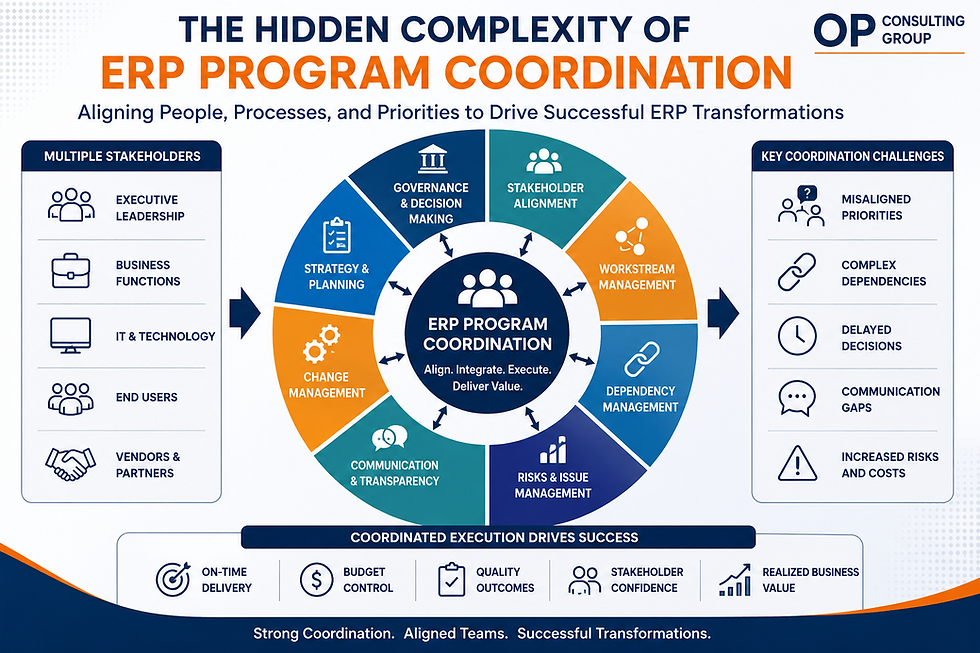
The Program Management Office is one of the most important operational structures within a public sector ERP program. In large transformation environments, the PMO functions as the coordination center responsible for managing schedules, dependencies, risks, vendors, governance activities, resource allocation, testing readiness, and deployment planning.
Many ERP programs fail because organizations underestimate the level of PMO maturity required to manage enterprise-scale transformation complexity.
Weak PMOs often focus heavily on administrative reporting while lacking authority to manage cross-functional coordination, unresolved dependencies, stakeholder conflicts, or operational escalation. As ERP complexity increases, fragmented PMO structures struggle to maintain alignment across technical teams, vendors, business workstreams, and executive governance groups.
A delayed decision within finance process design may affect integration development, testing schedules, training readiness, reporting configurations, and deployment planning simultaneously. Without centralized dependency management, these impacts often remain invisible until schedules begin slipping significantly.
Resource coordination is another major PMO challenge. ERP programs compete for highly specialized expertise across architecture, cybersecurity, testing, integration development, data migration, and organizational change management. Without disciplined planning, critical resources may become overallocated or unavailable during high-risk delivery periods.
Communication management also plays a major role in PMO effectiveness. Large ERP programs generate enormous volumes of operational information across multiple stakeholder groups. Executives require strategic risk visibility, operational teams need readiness guidance, and vendors require technical coordination.
Mature ERP PMOs establish centralized governance frameworks integrating risk management, vendor oversight, financial governance, stakeholder communication, dependency tracking, and operational readiness management across the entire transformation ecosystem.
Organizations with strong PMO maturity are significantly better positioned to maintain delivery stability during periods of operational pressure and implementation complexity.
4. Budget Overruns and Financial Governance Failures
Budget overruns remain one of the most visible risks associated with public sector ERP programs.
Large ERP initiatives frequently exceed original financial estimates because organizations underestimate implementation complexity, governance delays, testing requirements, organizational readiness costs, data migration effort, and vendor coordination challenges.
Industry research consistently shows that large ERP programs often exceed planned budgets by 30%–50% or more. Public sector implementations may experience even greater escalation due to regulatory requirements, procurement delays, political oversight, and decentralized operations.
One of the primary causes of cost escalation is uncontrolled scope expansion. During implementation, agencies frequently request additional functionality, custom workflows, reporting enhancements, or integration changes not included in the original program scope.
Without disciplined governance, these incremental additions gradually increase delivery complexity, extend implementation timelines, and significantly raise vendor costs.
Governance delays also create major financial consequences. Unresolved decisions related to process design, integrations, security requirements, or deployment sequencing may delay downstream workstreams across the program ecosystem.
As schedules extend, organizations incur additional costs related to consulting resources, infrastructure consumption, PMO operations, testing activities, and operational support.
Many organizations also underestimate the financial investment required for change management, training, deployment support, and post-go-live stabilization.
Mature ERP programs establish integrated financial governance frameworks linking budget oversight directly to scope management, risk governance, vendor performance, and milestone readiness. These organizations maintain contingency reserves capable of absorbing transformation complexity without destabilizing delivery.
Strong financial governance significantly improves cost control, stakeholder confidence, and long-term implementation sustainability.
5. Legacy Systems and Technical Debt
Legacy systems represent one of the largest operational barriers to successful public sector ERP modernization.
Many government institutions continue relying on decades-old systems supporting payroll, finance, procurement, grants management, budgeting, and compliance operations. Over time, these environments accumulate extensive technical debt through customization, temporary fixes, fragmented integrations, and undocumented operational workarounds.
ERP programs frequently discover that legacy systems contain inconsistent data structures, unsupported technologies, redundant business processes, and hidden dependencies not fully understood during early planning phases.
This creates substantial implementation risk.
Public sector organizations often lack comprehensive documentation regarding legacy business rules, interface dependencies, or operational procedures. Critical institutional knowledge may reside primarily with long-tenured employees approaching retirement or transition.
Integration complexity also increases significantly because many legacy systems must continue operating during ERP deployment phases. Organizations frequently maintain hybrid environments where old and new systems coexist for extended periods.
These coexistence models require complex middleware solutions, interface management, reconciliation processes, and operational coordination frameworks.
Legacy environments also contribute heavily to data quality problems. Duplicate records, inconsistent classifications, obsolete reporting logic, and fragmented governance standards complicate migration efforts and increase deployment risk.
Organizations that successfully manage legacy modernization challenges invest heavily in enterprise architecture assessment, process analysis, interface governance, and operational discovery activities early in the transformation lifecycle.
Rather than viewing legacy replacement solely as a technical upgrade, mature ERP programs approach modernization as a broader organizational redesign effort requiring long-term governance discipline and operational planning.
6. Data Migration and Data Quality Risks
Data migration is one of the highest-risk activities within any ERP implementation.
ERP systems depend on accurate enterprise data to support budgeting, payroll, procurement, reporting, compliance, and operational decision-making. When organizations migrate poor-quality data into ERP platforms, operational instability frequently follows.
Public sector institutions typically maintain large volumes of historical data spread across multiple legacy systems developed independently over many years. These environments often contain duplicate records, inconsistent coding structures, incomplete information, outdated classifications, and conflicting business logic.
During ERP transformation, organizations frequently discover that data governance maturity is far lower than expected.
Agencies may define vendors, financial accounts, procurement categories, or organizational hierarchies differently across departments. Reconciling these differences into standardized ERP master data structures becomes highly complex.
Data cleansing efforts often require substantially more time and resources than initially planned.
Poor data quality can create severe operational consequences after deployment. Payroll inaccuracies may disrupt employee compensation, procurement errors may delay purchasing operations, and inconsistent reporting structures may compromise financial accountability.
Testing quality is also heavily dependent on reliable data. Organizations conducting testing with unrealistic or incomplete datasets frequently fail to identify critical operational issues before deployment.
Successful ERP programs establish dedicated enterprise data governance structures early in implementation. Mature organizations define clear ownership accountability, cleansing standards, validation procedures, reconciliation controls, and migration testing frameworks across all business domains.
These programs also conduct multiple migration rehearsals under realistic operational conditions before production deployment.
Strong data governance significantly reduces operational disruption, reporting instability, and compliance risk after go-live.
7. Testing Failures and Deployment Readiness Gaps
Testing failures remain one of the most common causes of ERP deployment instability.
Public sector ERP ecosystems support highly interconnected business processes involving finance, procurement, payroll, HR, compliance reporting, security controls, and external integrations operating simultaneously.
Testing therefore extends far beyond validating individual transactions. Organizations must confirm that the entire operational ecosystem functions reliably under real-world conditions.
One of the largest problems within ERP testing is schedule compression.
When earlier implementation phases experience delays, organizations frequently attempt to recover lost time by shortening testing cycles. This introduces substantial risk because testing is often the first opportunity to validate whether enterprise processes function cohesively.
Compressed testing reduces defect resolution time, limits business participation, and increases the likelihood of unresolved issues remaining hidden until after deployment.
Many ERP programs also struggle with insufficient business user involvement during testing activities. Technical teams may validate configuration functionality successfully while operational stakeholders remain only partially engaged.
However, business users possess critical institutional knowledge regarding compliance obligations, operational timing dependencies, and real-world workflow behavior.
Environment instability further complicates testing governance. Large ERP programs require multiple development, testing, training, and staging environments operating simultaneously. Weak environment management frequently leads to configuration inconsistencies, incomplete deployments, interface synchronization failures, and operational disruption.
Deployment readiness is another commonly underestimated area.
Successful deployment requires more than technical configuration completion. Organizations must validate workforce readiness, support structures, cybersecurity controls, business continuity procedures, operational escalation frameworks, and post-production stabilization capabilities before go-live.
Mature ERP programs establish integrated testing governance models emphasizing end-to-end validation, realistic operational simulations, deployment rehearsals, and disciplined readiness criteria.
These organizations significantly reduce post-production instability and improve deployment confidence.
8. Stakeholder Resistance and Organizational Change Challenges
Organizational resistance is one of the most underestimated risks in public sector ERP transformation.
ERP programs fundamentally change how employees perform daily operations involving approvals, budgeting, procurement, reporting, payroll processing, compliance management, and enterprise decision-making.
Government institutions often maintain deeply institutionalized operational practices shaped by decades of policy evolution, regulatory interpretation, and organizational culture. Employees accustomed to legacy systems and historical workflows may view ERP transformation as disruptive, risky, or disconnected from operational realities.
Resistance frequently emerges when stakeholders believe standardized enterprise processes will reduce flexibility, disrupt mission-critical operations, or eliminate long-established workflows.
Communication failures often worsen organizational resistance.
Many ERP programs rely on generic modernization messaging without clearly explaining how operational responsibilities, approval structures, reporting procedures, or daily activities will change for employees.
Training deficiencies are another major issue.
Organizations often treat training as a late-stage technical activity focused narrowly on system navigation rather than broader operational readiness. Successful ERP adoption requires employees to understand governance expectations, process changes, cross-functional coordination requirements, and organizational impacts.
Leadership inconsistency also undermines workforce confidence. Employees quickly recognize when executive sponsors communicate conflicting priorities or fail to visibly support transformation objectives.
Public sector ERP programs additionally face high levels of change fatigue because organizations are often managing restructuring initiatives, compliance reforms, staffing pressures, and operational modernization simultaneously.
Successful organizations treat change management as a core enterprise discipline integrated throughout the implementation lifecycle.
Mature programs establish structured stakeholder engagement frameworks, role-based training strategies, leadership alignment models, organizational readiness assessments, and post-go-live support mechanisms designed to improve long-term workforce adoption.
Strong organizational readiness significantly improves deployment stability and long-term transformation sustainability.
9. Vendor Management and Procurement Complexity
Public sector procurement processes introduce substantial complexity into ERP implementation.
Unlike private sector organizations with greater contracting flexibility, government institutions must operate within highly regulated procurement environments emphasizing transparency, fairness, compliance, and fiscal accountability.
Large ERP programs frequently involve multiple vendors supporting software licensing, infrastructure management, cybersecurity, data migration, testing, integration development, and organizational change management simultaneously.
Coordinating these ecosystems requires sophisticated governance maturity.
One major challenge involves rigid procurement cycles that fail to align with evolving implementation realities. ERP transformation requirements frequently change as organizations discover new operational dependencies, data issues, or integration complexities during execution.
However, procurement regulations often make it difficult to rapidly onboard new expertise, modify scopes, or adjust contractual responsibilities.
Vendor accountability fragmentation also creates major operational risk.
When integration failures, testing defects, or deployment issues emerge, vendors operating under separate contracts may dispute ownership responsibilities rather than collaboratively resolving problems.
Organizations that prioritize lowest-cost procurement models frequently encounter additional challenges related to resource quality, staffing instability, and insufficient transformation expertise.
Vendor turnover further weakens continuity throughout multi-year implementations.
Successful ERP programs establish centralized vendor governance frameworks integrated directly into PMO operations.
These organizations maintain clear accountability structures, performance metrics, escalation procedures, and collaborative governance models focused on shared transformation outcomes rather than isolated contractual compliance.
Strong vendor governance significantly improves coordination efficiency, delivery stability, and implementation accountability.
10. Compliance, Security, and Regulatory Pressures
Compliance complexity is one of the defining characteristics of public sector ERP transformation.
Government organizations must satisfy extensive audit obligations, financial controls, procurement regulations, cybersecurity standards, records retention requirements, accessibility laws, and public accountability expectations simultaneously.
ERP systems therefore become critical governance platforms supporting enterprise compliance and institutional transparency.
One major challenge involves inconsistent regulatory interpretation across agencies.
Departments often develop independent operational procedures over time to address compliance requirements within localized environments. ERP standardization efforts frequently expose conflicts regarding approval structures, audit controls, reporting standards, and security policies.
Cybersecurity requirements significantly increase ERP governance complexity.
Modern ERP ecosystems support highly sensitive employee, financial, procurement, and operational data. Public institutions face growing pressure to strengthen access controls, identity management, encryption standards, monitoring frameworks, and incident response capabilities.
Segregation-of-duty governance also becomes increasingly important within integrated ERP environments.
Organizations must ensure employees cannot perform conflicting financial or operational responsibilities capable of creating fraud or compliance violations.
Audit readiness remains another major concern.
ERP systems must provide reliable traceability across procurement approvals, payroll processing, financial postings, vendor management, grants administration, and operational reporting activities.
Successful organizations integrate compliance governance directly into transformation planning from the beginning.
Mature ERP programs establish cross-functional governance councils involving audit teams, legal stakeholders, cybersecurity organizations, finance leaders, procurement executives, and operational managers.
These organizations significantly reduce compliance exposure while improving long-term governance stability.
11. Communication Breakdowns and Transformation Fatigue
Communication failure is one of the most common contributors to ERP instability.
Large transformation programs involve thousands of stakeholders operating across agencies, governance committees, vendors, operational teams, and executive leadership structures simultaneously.
Without disciplined communication governance, organizations quickly experience confusion regarding priorities, responsibilities, timelines, risks, and operational expectations.
One major problem involves disconnects between executive reporting and operational realities.
High-level dashboards may indicate implementation success while operational teams struggle with unresolved defects, testing delays, resource shortages, or integration instability.
This lack of transparency weakens governance effectiveness and delays corrective action.
Communication fragmentation also increases significantly in decentralized public sector environments.
Different agencies may maintain independent reporting structures, escalation processes, and governance practices, creating inconsistent messaging across the transformation ecosystem.
Transformation fatigue further intensifies organizational instability.
Public sector ERP programs often span multiple years while organizations simultaneously manage restructuring initiatives, policy reforms, staffing shortages, and operational modernization pressures.
Over time, employees may experience declining morale, reduced engagement, and resistance toward ongoing transformation activities.
Testing and deployment periods frequently create sustained workload pressure involving long hours, operational uncertainty, and increased stress across business teams.
Organizations that successfully manage transformation fatigue establish workforce sustainability strategies focused on organizational resilience, stakeholder engagement, transparent communication, phased deployment planning, and operational support.
These organizations maintain stronger workforce commitment and significantly improve long-term transformation endurance.
12. Risk Management Failures in ERP Delivery
Risk management failures are among the leading causes of ERP instability.
Many organizations maintain formal risk registers and governance dashboards yet fail to operationalize proactive mitigation strategies across the implementation lifecycle.
One major weakness involves delayed issue recognition.
Testing teams may identify recurring defects, infrastructure teams may observe environment instability, and business stakeholders may report readiness concerns independently without integrated governance structures connecting these signals into broader enterprise risk patterns.
Political pressure can further weaken risk transparency.
Public ERP programs often operate under intense scrutiny from leadership teams, oversight committees, and legislators. As a result, organizations may hesitate to escalate major risks early out of concern regarding budget scrutiny or reputational impact.
Optimistic planning assumptions also contribute heavily to implementation instability.
Organizations frequently establish aggressive timelines and compressed deployment schedules without sufficient contingency reserves to absorb transformation complexity.
Vendor coordination risks, cybersecurity exposure, testing instability, and organizational readiness gaps may therefore escalate rapidly when implementation pressure increases.
Successful ERP programs establish centralized risk governance frameworks integrated directly into enterprise PMO operations.
Mature organizations emphasize proactive escalation, realistic reporting, scenario planning, deployment rehearsals, and operational resilience rather than reactive issue management.
Strong risk governance significantly improves transformation stability and long-term delivery confidence.
13. Strategies for Successfully Navigating Public Sector ERP Challenges
Successfully navigating public sector ERP transformation requires disciplined governance, operational transparency, stakeholder alignment, and long-term execution maturity.
Organizations that achieve stable ERP outcomes consistently demonstrate several common characteristics.
First, they establish strong governance structures early in the implementation lifecycle. These frameworks clearly define decision authority, accountability ownership, escalation procedures, and cross-functional coordination responsibilities.
Second, successful organizations maintain active executive sponsorship throughout the transformation lifecycle. Leadership teams remain visibly engaged, support difficult operational decisions, and reinforce enterprise priorities consistently across all stakeholders.
Third, mature organizations adopt realistic implementation planning models grounded in operational readiness rather than political expectations.
Rather than attempting enterprise-wide transformation simultaneously, high-performing ERP programs frequently use phased deployment approaches aligned with organizational capability and risk tolerance.
PMO maturity is another major success factor.
Successful organizations establish enterprise PMOs capable of integrating governance management, vendor coordination, risk oversight, testing governance, resource planning, and deployment readiness across all transformation dimensions.
Strong business ownership also significantly improves implementation outcomes.
ERP transformation cannot operate solely as an IT initiative. Finance, procurement, HR, compliance, and operational leaders must actively participate in governance, process design, testing validation, and organizational readiness planning.
Organizations that prioritize workforce adoption through comprehensive change management strategies also achieve substantially better deployment stability.
Successful ERP programs integrate communication planning, stakeholder engagement, role-based training, leadership alignment, and post-go-live support throughout the transformation lifecycle.
Ultimately, successful ERP modernization depends on sustained governance discipline and enterprise execution maturity rather than implementation speed alone.
14. Building Sustainable ERP Governance Models
Sustainable governance is the foundation of long-term ERP success.
Public sector ERP programs require governance structures capable of managing enterprise complexity across multiple years while maintaining operational continuity, stakeholder alignment, financial accountability, and regulatory compliance.
One of the most important governance principles is clarity of authority.
Organizations must clearly define ownership for business process decisions, architecture standards, scope management, deployment readiness, vendor coordination, and operational escalation.
Executive governance structures should also balance strategic oversight with operational visibility.
Leadership teams require accurate insight into implementation conditions affecting testing readiness, deployment stability, organizational adoption, and risk exposure rather than relying solely on milestone reporting.
Integrated cross-functional coordination is equally critical.
ERP transformation affects finance operations, procurement workflows, cybersecurity controls, HR management, compliance reporting, and data governance simultaneously. Sustainable governance therefore requires centralized coordination across all transformation workstreams.
Business ownership must remain embedded throughout the program lifecycle.
Operational leaders should actively participate in process governance, testing validation, deployment planning, and long-term adoption management.
Risk governance maturity also distinguishes successful ERP programs.
Organizations with strong governance frameworks maintain centralized risk oversight integrating mitigation planning, escalation management, dependency tracking, and operational contingency planning across the enterprise.
Sustainable governance additionally extends beyond go-live.
Successful organizations establish long-term operational governance models supporting system optimization, cybersecurity updates, regulatory changes, vendor management, and continuous process improvement after deployment.
ERP governance is not simply about project control. It is about building institutional capability capable of supporting long-term digital transformation stability across the enterprise.
15. Conclusion
Public sector ERP transformation is one of the most complex enterprise modernization challenges facing government institutions today.
These programs fundamentally reshape how organizations manage finance, procurement, workforce operations, compliance, reporting, and enterprise governance across highly interconnected public ecosystems.
The largest ERP risks rarely originate from technology limitations alone.
Most transformation failures emerge from governance fragmentation, weak PMO coordination, organizational resistance, unrealistic timelines, poor communication management, inadequate testing discipline, insufficient stakeholder alignment, and limited operational readiness.
Successful ERP modernization therefore requires far more than software implementation.
Organizations must establish integrated governance frameworks capable of aligning leadership teams, operational stakeholders, vendors, compliance organizations, PMOs, and workforce readiness activities into a unified enterprise transformation model.
The most successful public sector ERP programs consistently prioritize governance maturity, operational transparency, executive alignment, workforce engagement, risk management, and disciplined execution throughout the implementation lifecycle.
They recognize that ERP transformation is not a short-term IT initiative but a long-term organizational modernization effort requiring sustained institutional commitment.
As governments continue investing heavily in digital transformation strategies, ERP systems will remain foundational components of enterprise modernization.
Organizations that strengthen governance maturity, organizational resilience, and execution discipline will be significantly better positioned to achieve stable ERP outcomes and long-term transformation success.
16. How OP Consulting Group Helps Public Sector ERP Programs Succeed
At OP Consulting Group, we understand that public sector ERP transformation is fundamentally an enterprise execution challenge requiring strong governance, operational coordination, stakeholder alignment, and long-term organizational readiness.
Our approach focuses on helping public institutions improve ERP governance maturity, strengthen PMO coordination, reduce transformation risk, and improve operational stability throughout the implementation lifecycle.
We support ERP programs through integrated advisory services spanning governance design, PMO transformation, risk management, testing governance, organizational readiness, deployment coordination, stakeholder engagement, and post-go-live stabilization.
OP Consulting Group works closely with executive leadership teams to establish sustainable governance frameworks capable of supporting large-scale public sector modernization initiatives.
Our consultants help organizations improve decision-making structures, escalation management, vendor coordination, dependency tracking, operational reporting, and enterprise-wide transformation visibility.
We also support public sector PMOs in evolving from administrative reporting functions into enterprise execution management organizations capable of coordinating highly complex ERP ecosystems.
Our methodology emphasizes operational transparency, proactive risk management, workforce readiness, testing discipline, and long-term governance sustainability.
Most importantly, OP Consulting Group recognizes that successful ERP modernization depends on balancing technology transformation with organizational resilience, operational continuity, and institutional accountability.
As governments continue navigating increasingly complex modernization demands, OP Consulting Group remains committed to helping public institutions improve ERP execution, strengthen governance maturity, reduce operational risk, and achieve sustainable transformation success.