Early Warning Signs Your ERP Program Is Going Off Track

Table of Contents
1.Introduction-Early Warning Signs Your ERP Program Is Going Off Track
Enterprise Resource Planning (ERP) programs are among the most complex transformation initiatives organizations undertake. They impact business processes, operational workflows, finance, procurement, supply chain, HR, customer operations, and executive decision-making across the enterprise. While ERP implementations are often launched with ambitious goals such as operational efficiency, automation, scalability, compliance, and improved visibility, many programs begin experiencing instability long before leaders recognize that the initiative is in trouble.
ERP failures rarely occur suddenly. Most programs deteriorate gradually through missed decisions, weak governance, stakeholder fatigue, poor communication, unresolved risks, and execution gaps that compound over time. In many cases, ERP programs continue appearing “green” in executive reports while operational instability is already spreading across workstreams. By the time major issues become visible, recovery becomes expensive, politically sensitive, and operationally disruptive.
Understanding the early warning signs of ERP instability is critical for organizations that want to protect transformation investments, maintain delivery momentum, and achieve successful deployment outcomes. Strong governance, independent execution visibility, proactive escalation management, and disciplined program leadership are essential to preventing ERP initiatives from drifting toward failure.
2.Why ERP Programs Begin Failing Before Anyone Notices
ERP programs often begin failing quietly because early-stage execution issues are hidden beneath extensive reporting structures, governance layers, and overly optimistic status updates. Large transformation programs generate massive volumes of data, meetings, dashboards, and presentations, which can create the illusion of progress even when underlying delivery problems are increasing.
Many organizations focus heavily on milestone tracking rather than execution quality. As a result, program leadership may continue reporting timeline adherence while unresolved dependencies, stakeholder conflicts, and operational readiness gaps continue growing behind the scenes. Small delays in design approvals, testing defects, data migration preparation, or integration development eventually compound into large-scale instability.
Another reason ERP programs fail unnoticed is that organizations often normalize dysfunction. Constant escalations, delayed decisions, resource shortages, and changing priorities become viewed as “typical ERP challenges” instead of indicators of structural delivery problems. Over time, the organization adapts to instability instead of addressing root causes.
ERP programs also suffer when executive stakeholders receive filtered information. Program teams may unintentionally minimize risks to maintain confidence, avoid scrutiny, or protect vendor relationships. This creates a dangerous disconnect between executive perception and operational reality.
Without independent execution oversight, ERP programs can continue drifting for months before leadership realizes deployment readiness is significantly compromised.
3.The Hidden Cost of ERP Execution Instability
ERP execution instability creates significant financial, operational, and organizational consequences that extend far beyond project budgets. While organizations typically measure ERP success through implementation costs and deployment timelines, the hidden costs of instability often become far more damaging over time.
One of the most immediate impacts is productivity loss. Teams spend increasing amounts of time attending escalation meetings, reworking deliverables, validating inaccurate data, resolving repeated defects, and managing communication breakdowns instead of progressing actual implementation work. This reduces overall delivery velocity and weakens organizational morale.
Execution instability also creates operational uncertainty. Business users begin losing confidence in the future-state system, resulting in lower participation during testing, training, and process validation activities. When business engagement declines, ERP design decisions become increasingly disconnected from operational realities.
Financially, unstable ERP programs generate growing consulting costs, vendor extensions, overtime expenses, and repeated remediation efforts. Delayed deployments may also impact revenue recognition, regulatory compliance, procurement operations, inventory management, or customer service capabilities.
Perhaps the most damaging hidden cost is organizational fatigue. ERP programs require sustained executive sponsorship, cross-functional alignment, and long-term stakeholder commitment. Continuous instability gradually erodes trust across departments, making future transformation initiatives significantly harder to execute successfully.
4.Why ERP Programs Often Look Healthy on Paper
ERP programs frequently appear healthy in executive dashboards even while delivery risks are rapidly increasing. This happens because traditional PMO reporting structures often emphasize schedule metrics, milestone completion percentages, and presentation-level status summaries rather than actual operational readiness.
Programs may continue reporting “green” status indicators despite major unresolved risks because reporting frameworks are not designed to measure execution quality. For example, a workstream may appear on schedule while critical testing defects remain unresolved, business process gaps continue expanding, or data migration accuracy remains uncertain.
In many cases, teams become incentivized to maintain positive reporting rather than escalate difficult realities. Program managers may fear triggering executive concern, vendor scrutiny, or governance intervention. As a result, risks become softened through vague language such as “manageable delays,” “minor dependencies,” or “under evaluation.”
Another common issue is milestone inflation. ERP programs sometimes measure progress based on document completion, meeting attendance, or workshop execution instead of validated business outcomes. This creates misleading perceptions of advancement while operational readiness remains weak.
Healthy ERP programs require transparent reporting structures that focus on execution confidence, decision velocity, risk aging, stakeholder alignment, and deployment readiness—not simply milestone tracking.
5.Governance Meetings Produce More Discussion Than Decisions
One of the clearest signs of ERP instability is when governance meetings generate extensive discussion but very few concrete decisions. Governance structures exist to accelerate resolution, remove blockers, prioritize actions, and maintain program momentum. When meetings become repetitive forums for status updates without accountability, execution begins slowing significantly.
In unstable ERP environments, the same issues are often discussed repeatedly across multiple steering committees, PMO reviews, and escalation meetings without clear ownership or resolution timelines. Teams spend excessive time revisiting problems instead of driving corrective action.
This decision paralysis creates cascading delays across workstreams. Integration dependencies remain unresolved, testing timelines shift, design approvals stall, and resource conflicts continue growing. Over time, delivery teams lose confidence in governance effectiveness and begin operating independently, creating further fragmentation.
Strong ERP governance requires disciplined decision management, executive accountability, issue ownership clarity, and escalation transparency. Governance meetings should focus on enabling delivery—not merely reporting problems.
6.ERP Stakeholders Start Losing Alignment
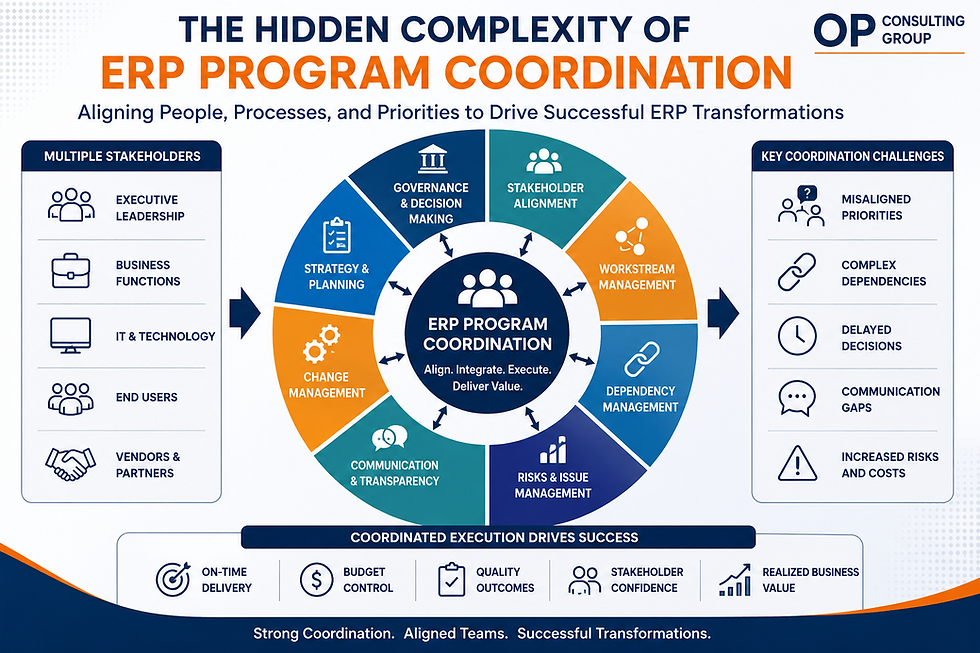
Stakeholder alignment is one of the most critical success factors in ERP transformations. As programs become more complex, maintaining consistent alignment across executives, business leaders, IT teams, vendors, and operational stakeholders becomes increasingly difficult.
Misalignment often begins subtly. Different departments develop conflicting expectations regarding timelines, scope priorities, process ownership, or deployment readiness. Some stakeholders prioritize speed while others focus on stability, compliance, or operational customization.
Without structured alignment mechanisms, these conflicting priorities create decision bottlenecks and execution confusion. Teams begin interpreting program objectives differently, resulting in inconsistent delivery expectations across workstreams.
As alignment weakens, trust also begins eroding. Business users may feel unheard, technical teams may feel overwhelmed by changing requests, and executives may receive inconsistent messaging from different leaders. Eventually, the ERP program loses unified organizational direction.
Successful ERP programs require continuous stakeholder engagement, transparent communication, aligned governance models, and shared accountability frameworks that keep all parties operating toward common transformation objectives.
7.Repeated Escalations Without Resolution
Repeated escalations are often a symptom of deeper structural problems within ERP execution governance. While escalations are normal in large transformation programs, unresolved escalations indicate weak decision ownership, unclear accountability, or ineffective governance intervention.
In struggling ERP programs, issues repeatedly move between teams, vendors, PMOs, and executives without clear resolution paths. Meetings become dominated by status updates on long-standing risks rather than proactive execution planning.
Over time, escalation fatigue spreads across the organization. Teams begin losing confidence that issues will actually be resolved, leading to disengagement and operational frustration. Some teams may stop escalating risks altogether because previous escalations produced little action.
This creates dangerous blind spots within the ERP program. Critical operational risks remain unresolved while leadership assumes stability exists because escalation volume appears lower.
Effective ERP governance requires structured escalation frameworks with defined ownership, decision deadlines, executive accountability, and measurable closure criteria.
8.ERP Timelines Begin Shifting Constantly
Frequent timeline changes are a major warning sign of ERP execution instability. While minor schedule adjustments are expected in complex programs, constant timeline movement indicates underlying delivery uncertainty and weak dependency management.
Timeline instability often begins with small delays in design approvals, testing readiness, integration development, or data validation activities. These delays create cascading impacts across downstream workstreams, forcing repeated schedule re-baselining.
As timeline changes become more common, organizational confidence begins declining. Business users struggle to plan operational readiness activities, training schedules become unreliable, and deployment preparation loses structure.
Frequent timeline shifts also increase financial pressure. Vendors extend contracts, project resources remain engaged longer than expected, and operational transition planning becomes increasingly difficult.
Stable ERP programs require disciplined dependency management, realistic planning assumptions, proactive risk mitigation, and transparent schedule governance that reflects operational realities rather than optimistic forecasts.
9.PMO Reporting Becomes Reactive Instead of Strategic
A high-performing ERP PMO operates as a strategic execution function that proactively identifies risks, drives accountability, and supports decision-making. However, in unstable ERP programs, PMO activities often become increasingly reactive.
Instead of anticipating execution challenges, PMOs begin spending most of their time updating reports, responding to escalations, collecting status information, and preparing governance presentations. This shifts focus away from proactive delivery management.
Reactive PMO behavior reduces visibility into emerging operational risks. Leadership receives delayed information, dependencies remain unresolved longer, and corrective actions happen too late to prevent schedule disruption.
Over time, the PMO becomes viewed as an administrative reporting function rather than a strategic execution partner. This weakens governance effectiveness and reduces leadership confidence in program visibility.
Strong ERP PMOs prioritize execution transparency, predictive risk analysis, decision acceleration, dependency management, and operational readiness oversight.
10.Business Users Start Disengaging From the ERP Program
Business engagement is essential for ERP success because operational users validate processes, confirm requirements, participate in testing, and support organizational adoption. When business users begin disengaging, ERP risk increases significantly.
Disengagement often occurs when users experience repeated delays, unclear communication, excessive meeting volume, or unresolved process concerns. Business teams may also lose confidence if they believe decisions are being driven primarily by vendors or IT teams without operational input.
As engagement declines, testing quality weakens, process validation gaps increase, and training effectiveness deteriorates. Critical operational scenarios may go untested, resulting in deployment instability after go-live.
Organizations must actively maintain business engagement through transparent communication, realistic planning, stakeholder inclusion, and clear demonstration that user feedback influences program decisions.
11.ERP Testing Cycles Reveal Increasing Operational Gaps
Testing phases often expose the true health of an ERP program. While earlier project stages may appear stable through documentation and workshops, testing reveals whether the system actually supports operational business requirements.
In unstable ERP programs, testing cycles produce increasing numbers of defects, process failures, integration breakdowns, and data inconsistencies. Business users may identify gaps between designed processes and real operational workflows.
Testing instability also creates downstream deployment risk. Defect remediation consumes additional resources, retesting timelines expand, and confidence in deployment readiness declines.
Successful ERP testing requires disciplined defect governance, business participation, integration stability, realistic operational scenarios, and strong quality assurance leadership.
12.Data Migration Problems Continue Growing
Data migration remains one of the highest-risk components of ERP implementation. Poor data quality, inconsistent ownership, incomplete cleansing, and weak validation processes can significantly delay deployment readiness.
As ERP programs struggle, data migration issues often compound over time. Duplicate records, missing master data, inconsistent formats, and reconciliation failures create operational uncertainty across finance, procurement, inventory, and customer processes.
Data instability also impacts testing quality because inaccurate data prevents reliable scenario validation. Business users lose confidence when test environments fail to reflect operational realities.
Organizations must prioritize data governance early in ERP programs, establish clear ownership structures, and continuously validate migration readiness throughout implementation.
13.ERP Integration Dependencies Become Unstable
Modern ERP environments rely heavily on integrations between finance systems, procurement tools, HR platforms, CRM solutions, warehouse applications, and external vendor systems. Integration instability creates significant operational risk.
When integration dependencies become unstable, testing delays increase, data synchronization problems emerge, and downstream process execution becomes unreliable. Integration failures often reveal broader architectural and governance weaknesses within the ERP program.
Strong integration governance requires dependency visibility, technical ownership clarity, proactive testing coordination, and realistic environment management strategies.
14.Executive Sponsors Become Less Engaged
Executive sponsorship is critical for maintaining organizational alignment, decision velocity, and transformation momentum. When executive engagement declines, ERP programs lose strategic direction and governance effectiveness.
Sponsors often disengage when programs become dominated by repetitive escalations, unclear reporting, or prolonged instability. Over time, leaders may shift focus toward other priorities if confidence in ERP execution begins weakening.
Reduced executive involvement slows decision-making, weakens accountability enforcement, and creates uncertainty across teams. Delivery organizations begin operating without consistent strategic guidance.
Sustained executive engagement requires transparent reporting, actionable governance discussions, clear escalation paths, and measurable progress visibility.
15.ERP Scope Expansion Starts Accelerating
Scope expansion is a common source of ERP instability. As programs progress, stakeholders often request additional features, customizations, reports, integrations, or process adjustments that were not part of the original implementation plan.
Without disciplined scope governance, these requests accumulate rapidly and overwhelm delivery capacity. Teams lose focus, timelines shift, testing complexity increases, and deployment risk grows significantly.
Organizations must establish clear scope control frameworks that balance operational needs with delivery stability. Strong governance ensures that new requests are evaluated based on business value, operational necessity, and implementation impact.
16.Communication Across Workstreams Breaks Down
ERP programs depend on continuous coordination across technical teams, business functions, vendors, and leadership groups. When communication begins breaking down, execution fragmentation accelerates quickly.
Teams may operate with conflicting assumptions, incomplete information, or inconsistent priorities. Dependencies become misunderstood, risks are not escalated properly, and decisions fail to reach impacted stakeholders.
Poor communication also increases organizational frustration. Teams spend more time clarifying misunderstandings, resolving conflicts, and repeating discussions instead of progressing implementation work.
Strong ERP communication frameworks require structured reporting, cross-functional alignment sessions, centralized decision tracking, and transparent stakeholder engagement strategies.
17.ERP Vendors and Internal Teams Start Blaming Each Other
Blame culture is one of the strongest indicators of ERP execution deterioration. When delivery instability increases, vendors and internal teams may begin protecting themselves instead of collaborating toward resolution.
Internal teams may accuse vendors of poor execution, while vendors may argue that business decisions, scope changes, or delayed approvals caused instability. This adversarial environment weakens trust and slows corrective action.
Blame-focused cultures create defensive reporting behaviors, fragmented accountability, and reduced transparency. Teams become more focused on protecting reputations than solving operational problems.
Successful ERP programs foster shared accountability models where all parties focus on delivery outcomes, operational readiness, and collaborative problem-solving.
18.Decision-Making Slows Across the ERP Program
Slow decision-making creates cascading instability across ERP implementations. Design approvals, process ownership decisions, resource allocations, and deployment readiness actions all require timely governance intervention.
When decisions slow, workstreams lose momentum, dependencies remain blocked, and teams begin making assumptions independently. This increases rework, operational inconsistency, and governance confusion.
Decision delays often stem from unclear ownership structures, executive disengagement, stakeholder conflict, or excessive governance layers.
High-performing ERP programs maintain structured decision frameworks with defined escalation timelines, accountable owners, and transparent governance accountability.
19.ERP Risks Remain Open for Long Periods
ERP programs naturally generate risks, but healthy programs actively manage and close them. When risks remain unresolved for extended periods, execution instability begins compounding rapidly.
Aging risks often indicate governance inaction, resource shortages, unclear ownership, or ineffective escalation management. Over time, unresolved risks transition into operational failures.
Organizations should continuously monitor risk aging, escalation velocity, mitigation effectiveness, and dependency exposure to maintain delivery stability.
20.ERP Teams Focus More on Reporting Than Delivery
As ERP programs struggle, teams often become consumed by governance reporting, executive presentations, and escalation documentation. Excessive reporting requirements reduce actual delivery productivity.
Teams may spend more time preparing status updates than resolving operational blockers. This creates administrative overload and weakens execution momentum.
Strong ERP governance balances visibility with operational effectiveness. Reporting should enable faster decisions and clearer accountability—not create additional delivery burdens.
21.Business Confidence in the ERP Program Starts Declining
Business confidence is essential for organizational adoption and deployment success. When users begin losing confidence, resistance increases across training, testing, and operational readiness activities.
Declining confidence often stems from repeated delays, inconsistent communication, unresolved defects, or leadership uncertainty. Users may begin preparing manual workarounds because they no longer trust deployment readiness.
Organizations must proactively rebuild confidence through transparency, realistic planning, operational engagement, and visible corrective actions.
22.ERP Deployment Readiness Becomes Increasingly Unclear
Deployment readiness confusion is a major warning sign of ERP instability. Teams may disagree on whether testing is sufficient, integrations are stable, data is accurate, or operational support models are prepared.
Without clear readiness criteria, deployment decisions become subjective and politically driven rather than operationally validated.
Successful ERP deployments require measurable readiness frameworks covering testing completion, defect severity, training readiness, cutover planning, support models, and operational contingency preparation.
23.Operational Teams Start Building Workarounds
When operational users lose confidence in ERP readiness, they often begin developing manual processes, spreadsheets, shadow systems, or temporary operational workarounds.
While these workarounds may reduce short-term risk, they create long-term operational fragmentation and weaken ERP standardization objectives.
Organizations must identify workaround behavior early and address underlying trust, communication, and readiness concerns before deployment.
24.ERP Program Fatigue Starts Spreading Across the Organization
Long-running ERP instability creates organizational exhaustion. Teams become overwhelmed by repeated escalations, shifting timelines, governance pressure, and operational uncertainty.
Program fatigue reduces productivity, weakens morale, increases turnover risk, and lowers stakeholder engagement across the enterprise.
Leadership must actively manage transformation fatigue through realistic planning, transparent communication, recognition programs, and sustainable execution practices.
25.Why ERP Programs Need Independent Execution Visibility
Independent execution visibility provides organizations with objective insight into actual program health beyond standard PMO reporting structures. Independent oversight helps identify hidden delivery risks, governance weaknesses, stakeholder misalignment, and operational readiness gaps before they become critical failures.
External execution visibility also improves executive confidence by providing unbiased assessments of delivery stability, decision effectiveness, and deployment readiness.
Organizations that establish independent governance oversight are better positioned to stabilize ERP execution before problems escalate significantly.
26.How Strong ERP Governance Prevents Program Failure
Strong ERP governance creates the structure, accountability, and decision discipline necessary to maintain transformation stability. Effective governance frameworks enable rapid escalation resolution, clear accountability ownership, transparent communication, and proactive risk management.
Strong governance also aligns executive leadership, vendors, PMOs, and business stakeholders around shared delivery objectives. This reduces fragmentation and improves organizational coordination.
Most importantly, governance creates execution transparency that allows organizations to identify instability early and implement corrective actions before deployment readiness is compromised.
27.How OP Consulting Group Helps ERP Programs Stay on Track
OP Consulting Group helps organizations strengthen ERP execution through independent governance oversight, program stabilization support, PMO leadership, stakeholder alignment, operational readiness assessments, and risk management frameworks.
By providing objective execution visibility, OP Consulting Group helps leadership identify hidden delivery risks, accelerate decision-making, improve governance accountability, and maintain deployment readiness across complex ERP transformations.
The firm works alongside executive sponsors, PMOs, vendors, and business stakeholders to ensure ERP programs remain aligned, transparent, and execution-focused throughout the transformation lifecycle.
28.Conclusion
The Early Warning Signs Your ERP Program Is Going Off Track are often visible long before a major failure occurs. These warning signs typically appear through delayed decisions, recurring escalations, shifting timelines, unresolved risks, stakeholder misalignment, testing failures, data migration instability, communication breakdowns, and declining business engagement. While these issues may initially seem manageable, they gradually weaken program execution and create operational uncertainty across the organization.
ERP programs rarely fail because of one isolated problem. Instead, failure develops through the accumulation of governance weaknesses, poor execution discipline, inconsistent leadership involvement, unstable integrations, uncontrolled scope expansion, and slow decision-making. Organizations that ignore these early indicators often discover problems only when deployment readiness, operational stability, and business confidence are already significantly compromised.
Recognizing the Early Warning Signs Your ERP Program Is Going Off Track allows organizations to intervene early, stabilize execution, improve accountability, and reduce transformation risk before issues escalate into major operational or financial consequences. Early visibility enables leadership teams to strengthen governance, accelerate decision-making, improve stakeholder alignment, and restore confidence across workstreams.
Successful ERP transformation requires far more than technical implementation. It demands strong governance structures, transparent communication, proactive risk management, executive sponsorship, operational readiness, and continuous execution oversight. Organizations that actively monitor the Early Warning Signs Your ERP Program Is Going Off Track are far better positioned to protect their ERP investment, maintain delivery momentum, and achieve long-term business transformation success.
Ultimately, organizations that identify and address the Early Warning Signs Your ERP Program Is Going Off Track early in the implementation lifecycle can avoid costly delays, reduce deployment instability, improve business adoption, and ensure their ERP program delivers measurable operational value and sustainable enterprise growth.