ERP PMO Success: Why Enterprise Resource Planning (ERP) Without a Project Management Office (PMO) Control Tower Fails

Table of Contents
Introduction: ERP PMO Success Starts with a Control Tower
Why ERP PMO Success Matters in Modern ERP Implementations
ERP PMO Success as the Control Tower of Transformation
What Happens Without ERP PMO Success
Governance and ERP PMO Success
Strategic Alignment and ERP PMO Success
Risk Management and ERP PMO Success
Change Management and ERP PMO Success
ERP Failure vs ERP PMO Success: A Narrative Comparison
Industry-Specific ERP PMO Success
Recognizing When an ERP Program Needs Stronger PMO Support
Evaluating Readiness for ERP PMO Success
How OP Consulting Group Enables ERP PMO Success
Conclusion: ERP PMO Success Is the Difference
Frequently Asked Questions (FAQ)
1. Introduction: ERP PMO Success Starts with a Control Tower
At any busy airport, dozens—sometimes hundreds—of aircraft move simultaneously. Each flight has its own destination, schedule, constraints, and dependencies. Pilots rely on instruments, airlines rely on schedules, and passengers rely on coordination. Yet despite this overwhelming complexity, the system works with remarkable precision.
The reason is simple: there is a control tower.
The control tower does not fly the aircraft. It does not build them, fuel them, or maintain them. Yet it plays the most critical role—ensuring coordination, sequencing, safety, and real-time decision-making. It sees the full picture when others only see their own path.
This is exactly what defines ERP PMO success.
Organizations invest millions—sometimes billions—into Enterprise Resource Planning (ERP) platforms like SAP S/4HANA, Oracle Cloud ERP, PeopleSoft, Workday, and Microsoft Dynamics. These systems promise integration, efficiency, automation, and data-driven decision-making.
But despite this promise, ERP programs often struggle—not because the technology fails, but because coordination fails.
Without a centralized Project Management Office (PMO), ERP programs begin to drift. Teams move independently, decisions are made in silos, and priorities become misaligned.
ERP PMO success is not about software. It is about orchestration—ensuring that every moving part in a complex transformation operates in sync.
2. Why ERP PMO Success Matters in Modern ERP Implementations
ERP PMO success becomes essential when organizations begin to understand the scale and interconnectedness of ERP initiatives.
An implementation of SAP S/4HANA redefines financial operations and reporting structures. Oracle Cloud ERP standardizes global processes across business units. Workday transforms human capital management and workforce analytics. PeopleSoft supports complex operations in higher education and government, while Microsoft Dynamics integrates financial and operational systems for growing enterprises.
Each of these platforms introduces multiple workstreams that must function as a single system.
Without ERP PMO success, these workstreams operate independently. Teams may meet individual milestones, but the program as a whole begins to lose cohesion.
ERP PMO success ensures synchronization, alignment, and shared accountability across all functions.
3. ERP PMO Success as the Control Tower of Transformation
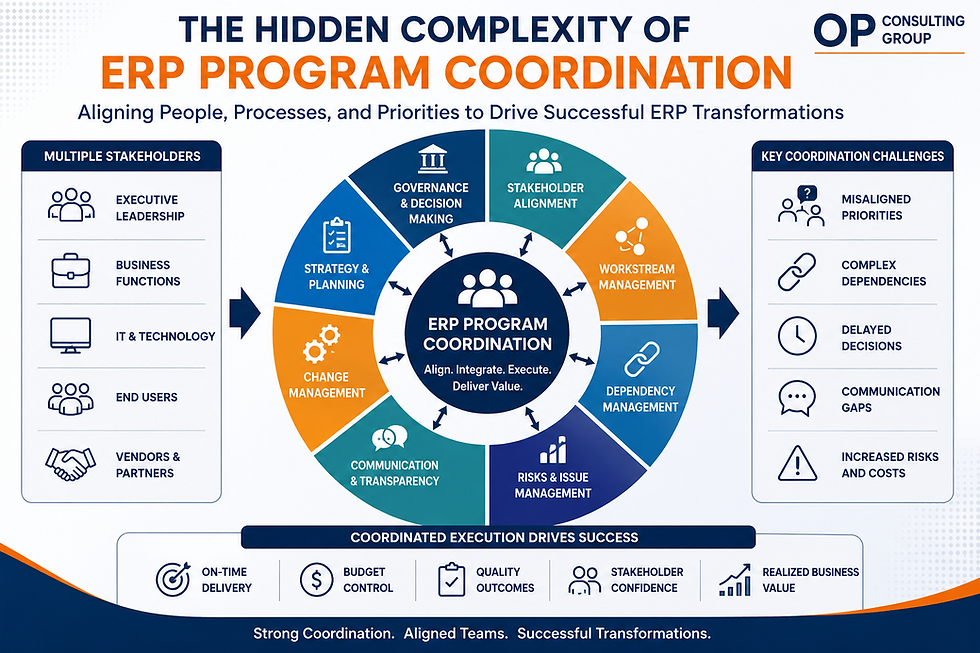
ERP PMO success provides the visibility needed to manage complexity.
In any ERP program, dependencies are constant and often invisible without centralized oversight. A delay in data migration impacts testing. A change in HR configuration affects payroll. Integration timelines influence reporting readiness.
In systems like Workday, PeopleSoft, and Microsoft Dynamics, these interdependencies are especially pronounced.
ERP PMO success creates a unified view of these interactions. It ensures that teams are not only aware of their own deliverables but also understand how their work impacts others.
This alignment transforms fragmented execution into coordinated delivery.
4. What Happens Without ERP PMO Success
ERP programs rarely fail due to a single major issue. They fail gradually.
A missed dependency here. A delayed decision there. A misalignment in requirements that leads to rework.
In large-scale implementations such as SAP S/4HANA or Oracle Cloud ERP, these small issues compound quickly due to the tightly integrated nature of the systems.
Without ERP PMO success, communication becomes fragmented, decision-making slows, and risks escalate.
The result is not just delays—it is loss of direction.
ERP PMO success prevents this drift by establishing structure, accountability, and visibility.
5. Governance and ERP PMO Success
Governance is the foundation of ERP PMO success.
In complex ERP environments, decisions often have cross-functional implications. A change in one module can impact multiple departments.
ERP PMO success ensures that governance frameworks define how decisions are made, who is accountable, and how issues are escalated.
This clarity reduces ambiguity and enables faster execution.
6. Strategic Alignment and ERP PMO Success
ERP programs are driven by strategic objectives, but execution often shifts focus toward tasks.
ERP PMO success ensures that the program remains aligned with its intended outcomes.
In implementations of SAP S/4HANA or Microsoft Dynamics, this alignment is critical to ensure that progress translates into business value.
The PMO continuously connects execution with strategy.
7. Risk Management and ERP PMO Success
Risk is inherent in ERP programs.
Data migration, integrations, vendor dependencies, and user adoption challenges are common across platforms like Oracle Cloud ERP, Workday, and PeopleSoft.
ERP PMO success ensures that risks are identified early and managed proactively.
This reduces uncertainty and improves decision-making.
8. Change Management and ERP PMO Success
ERP success depends on people.
Systems like SAP S/4HANA and Workday introduce new workflows that require adaptation.
ERP PMO success ensures that communication, training, and stakeholder engagement are integrated into the program.
This drives adoption and long-term success.
9. ERP Failure vs ERP PMO Success: A Narrative Comparison
In struggling ERP programs, teams operate independently. Finance progresses while integrations lag. HR finalizes configurations without full visibility.
Decisions are delayed. Communication is inconsistent.
In contrast, ERP PMO success creates alignment.
There is a centralized view of progress. Dependencies are managed proactively. Governance ensures timely decisions.
The difference is structure.
10. Industry-Specific ERP PMO Success
ERP PMO success varies by industry.
Public Sector
ERP programs involving PeopleSoft or Oracle Cloud ERP must navigate regulations, budgets, and multiple stakeholders. PMO ensures transparency and coordination.
Healthcare
ERP systems like SAP S/4HANA and Oracle Cloud ERP must integrate financials, supply chains, and compliance. PMO ensures operational continuity.
Higher Education
Institutions rely on PeopleSoft and Workday in decentralized environments. PMO ensures alignment across campuses and departments.
11. Recognizing When an ERP Program Needs Stronger PMO Support
Signs of misalignment often appear early.
Unclear ownership, inconsistent reporting, scope changes, and delayed decisions indicate gaps in ERP PMO success.
Recognizing these signs early enables corrective action.
12. Evaluating Readiness for ERP PMO Success
ERP PMO success begins with readiness.
Organizations must assess governance, stakeholder alignment, communication, and risk management.
A structured evaluation provides clarity and direction.
13. How OP Consulting Group Enables ERP PMO Success
OP Consulting Group LLC specializes in ERP PMO success across platforms including SAP S/4HANA, Oracle Cloud ERP, PeopleSoft, Workday, and Microsoft Dynamics.
The firm designs tailored PMO frameworks that ensure governance, alignment, and execution discipline.
Its focus is on delivering measurable outcomes.
14. Conclusion: ERP PMO Success Is the Difference
ERP programs are complex.
Without ERP PMO success, complexity leads to confusion.
With ERP PMO success, complexity becomes manageable.
It is the difference between implementation and transformation.
15. Frequently Asked Questions (FAQ)
What is ERP PMO success? ERP PMO success refers to effective governance and coordination of an ERP program through a structured PMO.
Why is ERP PMO success important? It ensures alignment, reduces risk, and improves delivery outcomes.
Which ERP systems benefit from PMO? SAP S/4HANA, Oracle Cloud ERP, PeopleSoft, Workday, and Microsoft Dynamics all benefit significantly.
What are signs of poor ERP PMO success? Missed deadlines, unclear ownership, poor communication, and scope creep.
How can organizations improve ERP PMO success? By strengthening governance, alignment, and structured execution practices.