Why PMO Governance is Critical to Project Success
Updated: Apr 28

Introduction: The Rising Importance of PMO Governance
Organizations across industries are launching ambitious projects at unprecedented rates—digital transformation programs, ERP upgrades, cloud migrations, regulatory compliance initiatives, and enterprise modernization efforts. Yet, despite advances in methodologies, certifications, and project management software, the results remain disappointing.
According to PMI’s Pulse of the Profession, nearly two-thirds of projects fail to meet time, budget, or scope goals. McKinsey research shows large-scale IT projects often run 45 percent over budget and deliver 56 percent less value than predicted. These numbers highlight a harsh truth: traditional project management practices are not enough.
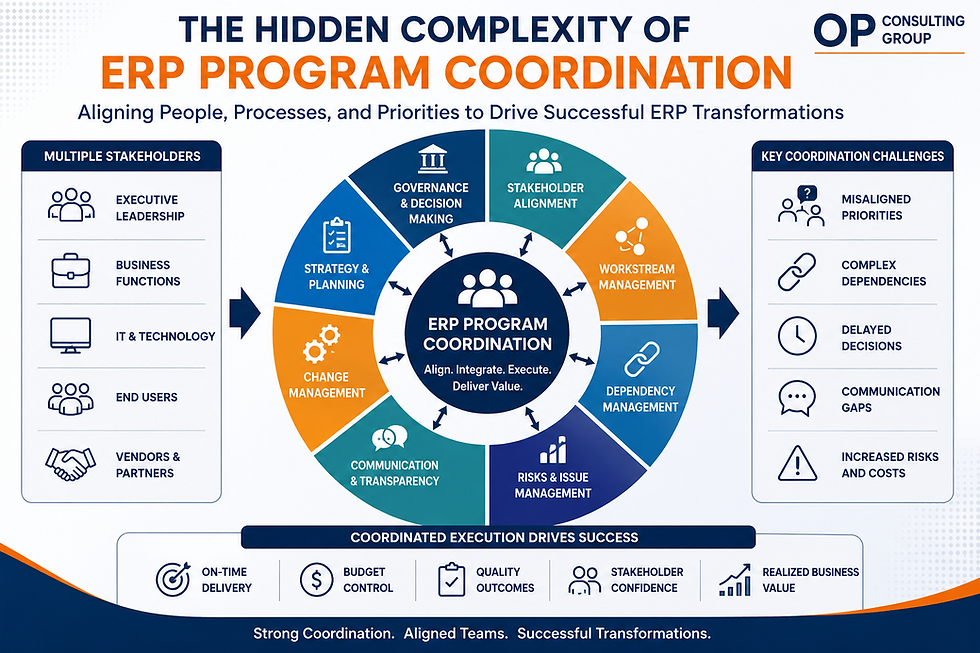
The real differentiator between success and failure is PMO governance. While project managers focus on day-to-day execution, governance ensures oversight, alignment, accountability, and transparency at a higher level. It bridges the gap between strategy and execution, ensuring that every initiative contributes to business objectives and delivers measurable value.
At OP Consulting Group LLC, we’ve seen firsthand how organizations transform when they embed strong governance into their PMO structures. Governance is not about adding red tape—it is about creating a disciplined framework where projects succeed consistently, resources are optimized, and executives have confidence in outcomes.
Understanding PMO Governance
To grasp why PMO governance is critical, it helps to first understand what it means. A Project Management Office (PMO) is the organizational body that standardizes project practices, provides resources, and in some cases directly manages initiatives. Governance, on the other hand, refers to the rules, processes, and decision-making frameworks that guide how projects are selected, executed, monitored, and evaluated.
Think of the PMO as the delivery engine and governance as the steering system. A PMO without governance risks becoming a support function with little authority. Governance without a PMO risks being theoretical without practical enforcement. Together, they provide both structure and execution discipline.
Different organizations establish different PMO models. A supportive PMO offers guidance and templates with limited enforcement. A controlling PMO requires compliance with defined methodologies and frameworks. A directive PMO goes further, directly managing major programs and assigning project managers. Governance adapts to each of these models, but in every case, it ensures alignment and accountability.
Frameworks such as PRINCE2, PMI’s PMBOK Guide, COBIT, and ISO 21500 provide foundations for governance. Each emphasizes different aspects—PRINCE2 focuses on structured stage gates, COBIT on IT governance, and PMBOK on knowledge areas and processes. Organizations typically tailor these frameworks to suit culture, regulatory requirements, and industry context.
Regardless of framework, certain principles define effective project governance: oversight, ensuring that progress and risks are monitored; accountability, clarifying roles and responsibilities; standardization, providing consistency in methodologies and reporting; and transparency, ensuring stakeholders have visibility into project performance.
The Role of PMO Governance in Project Success
Strong PMO governance ensures that projects are not just executed but executed with purpose and alignment. Without governance, organizations risk investing in initiatives that drain resources without delivering value. With governance, every project is strategically aligned, monitored effectively, and executed with discipline.
One of governance’s most critical roles is linking strategy to execution. Too often, organizations launch projects based on trends, executive preferences, or immediate pressures rather than strategic evaluation. Governance introduces rigor, requiring projects to be assessed against business objectives, budgets, and long-term priorities. This ensures alignment and prevents waste.
Governance also plays a vital role in risk management. Projects inherently involve uncertainty. Without structured governance, risks may be identified late or escalated ineffectively. Governance defines risk frameworks, escalation paths, and decision rights so that issues are addressed proactively at the appropriate level.
Stakeholder alignment is another essential outcome. Many projects fail not because deliverables were technically flawed but because stakeholders were misaligned or disengaged. Governance enforces structured communication, stakeholder engagement strategies, and decision-making transparency.
Finally, governance ensures effective portfolio balancing. It prevents organizations from spreading resources too thin across too many projects or focusing narrowly on short-term wins. By reviewing and prioritizing the entire portfolio, governance ensures resources are allocated to initiatives with the highest return and strategic value.
For executives seeking consulting expertise to realign their portfolio strategy, OP Consulting Group provides tailored frameworks for governance, PMO setup, and long-term project execution.
Critical Benefits of PMO Governance
The benefits of strong governance extend across people, processes, and financial outcomes.
Resource utilization improves dramatically. Without governance, resources are often stretched across too many initiatives, underutilized, or misallocated. Governance enforces demand management and capacity planning, ensuring optimal deployment of talent.
Governance also introduces standardization, which eliminates the confusion of fragmented methodologies. Teams work from consistent templates, workflows, and reporting structures, improving efficiency and enabling accurate comparisons across projects.
Financial discipline is strengthened as well. With governance, budgets are tracked, benefits are quantified, and return on investment (ROI) is measured. This allows executives to make data-driven decisions and ensures accountability for every dollar spent.
In regulated industries, governance ensures compliance and auditability. By embedding controls and documentation into processes, organizations avoid penalties and protect reputational integrity.
Finally, governance fosters a culture of accountability and continuous improvement. Lessons learned are systematically captured and applied, driving maturity across the enterprise.
At OP Consulting Group, we help organizations not only define governance but also staff the right project talent—PMs, analysts, ERP experts—who understand how to work within governance frameworks and deliver results.
Common Challenges Without PMO Governance
Without governance, projects often descend into chaos. Scope creep runs unchecked as new features are added without evaluation. Priorities shift constantly, diluting focus and wasting resources. Visibility is poor, leaving executives unaware of delays or risks until it’s too late. Each project team develops its own methods, creating inefficiencies and silos.
Ultimately, the lack of governance normalizes failure. Organizations begin to expect overruns and delays as part of business as usual. According to Why So Many High-Profile Digital Transformations Fail from Harvard Business Review, many organizations underestimate the strategic, organizational, and governance changes required for transformation efforts. Weak decision-making structures, misaligned incentives, or insufficient oversight are often underlying causes.
Case Studies: PMO Governance in Action
Real-world examples demonstrate both the benefits of governance and the costs of neglecting it.
A Fortune 100 company began a global ERP transformation without robust governance. The initiative quickly derailed, suffering $200 million in overruns and years of delays. After introducing a directive PMO with governance boards, risk escalation protocols, and portfolio oversight, the program recovered, delivering 90 percent of planned benefits.
In the public sector, a U.S. state government successfully modernized its PeopleSoft Time and Labor system by embedding governance structures. Steering committees, risk logs, and standardized templates ensured alignment across campuses and enabled disciplined execution. The project closed on time and within 5 percent of budget—a rarity for state-level IT initiatives.
On the other hand, the UK’s National Health Service (NHS) provides a cautionary tale. Its National Programme for IT, once the largest government IT project in Europe, collapsed after billions of pounds were spent. Analysts cite weak governance—unclear accountability, lack of stakeholder engagement, and poor oversight—as a primary reason for failure.
These cases highlight the central truth: governance is not optional. It directly determines project outcomes.
Best Practices for Strong PMO Governance
Organizations that succeed with governance embed certain practices into their culture. They begin by defining roles and responsibilities clearly, ensuring accountability and decision clarity. They establish governance committees—steering groups, risk boards, and change advisory boards—to provide structured oversight.
Metrics and KPIs are tracked rigorously. Instead of vanity metrics, organizations focus on schedule variance, cost performance index, benefits realization, and stakeholder satisfaction.
Governance is also tailored to delivery models. In hybrid environments, governance balances Agile flexibility with oversight, focusing on value delivery rather than excessive bureaucracy.
Finally, technology amplifies governance. Tools like Microsoft Project Online, Jira Portfolio, and Clarity provide dashboards and real-time reporting that enhance transparency and enable evidence-based decisions.
For organizations unsure where to begin, OP Consulting Group helps design governance models, set up PMOs, and implement the right tools and processes to scale governance across portfolios.
Future of PMO Governance
The future of project governance will be shaped by technology, workforce models, and societal expectations.
Artificial intelligence is beginning to support governance by providing predictive analytics that highlight risks, resource conflicts, and potential delays before they occur. As Gartner notes in its research on the future of project management, AI-driven insights will increasingly augment governance decision-making.
Hybrid project environments will become standard. Governance must flex to oversee Waterfall, Agile, and iterative methods without imposing rigidity.
With distributed and remote teams, governance frameworks must adapt to digital collaboration tools, ensuring accountability and visibility across geographies.
Finally, governance will increasingly integrate Environmental, Social, and Governance (ESG) considerations. Projects will be evaluated not only for ROI but also for contributions to sustainability and social impact. Governance will ensure alignment with both financial and societal objectives.
Conclusion: Why PMO Governance is Non-Negotiable
Project success is never an accident. It is the result of intentional alignment, disciplined oversight, and structured decision-making. PMO governance provides the framework that ensures projects deliver measurable value, risks are mitigated, and resources are deployed strategically.
Organizations that neglect governance suffer wasted investment, frustrated stakeholders, and weakened competitiveness. Those that embrace it build resilient, high-performing ecosystems capable of executing strategy with precision.
At OP Consulting Group, we specialize in helping organizations embed governance into their PMOs, design effective frameworks, and staff the right talent to sustain them. Whether you need advisory services, project leadership, or specialized staffing, our consulting and staffing solutions help organizations achieve project success.
In an era defined by disruption and rapid change, PMO governance is not optional—it is mission-critical. It is the difference between wasted potential and long-term success.